Wednesday, 23 August 2017

New Study Connects Olfactory Loss with Alzheimer's Disease

Promising finding suggests odour identification tests may help scientists track the evolution of the disease in persons at risk

By the time you start losing your memory, it's almost too late. That's because the damage to your brain associated with Alzheimer’s disease (AD) may already have been going on for as long as twenty years. Which is why there is so much scientific interest in finding ways to detect the presence of the disease early on. Scientists now believe that simple odour identification tests may help track the progression of the disease before symptoms actually appear, particularly among those at risk.

Wednesday, 16 August 2017

Advice for older adults on staying cool in hot weather

Risk of heat-related health problems increases with age.

With summer here and the temperatures rising, it is important to understand the health risks that excessive heat can bring and know the signs of heat-related illnesses. Older adults and people with chronic medical conditions are particularly susceptible to hyperthermia and other heat-related illnesses. The National Institute on Aging (NIA), part of the National Institutes of Health, offers advice to help combat the dangers of hot weather.
Heat stress, heat fatigue, heat syncope (sudden dizziness after exercising in the heat), heat cramps and heat exhaustion are all forms of hyperthermia. Hyperthermia is caused by a failure of the body’s heat-regulating mechanisms. The risk of hyperthermia can increase with the combination of higher temperatures, underlying general health, and individual lifestyle.

Tuesday, 15 August 2017

Rent Help for Seniors Living in Rental Suites

“Seniors are being displaced" - Karsten Kaemling, assistant manager of support and information services at the West End Seniors Network.Many senior renters have been in the same building for decades and when they're forced to find new accommodations, rental rates are much higher than what they’ve been previously paying. Annual rent increases can also start to put a squeeze on seniors’ limited incomes.Increasing rents mean many seniors have less and less money for other things — cable, food and other expenses often fall by the wayside in an effort to pay for housing.“What complicates a lot of things as well is they become isolated,”  some end up forgoing a proper diet or withdrawing from social or recreational activities, as a larger percentage of their income has to go to housing.Read More: Seniors Giving Up Quality of Life to Pay Rent
Getting Help With Rent

Vancouver Rent Bank can offer a short term funding source that is available to families and individuals that live in the City of Vancouver, at risk of eviction or essential utility disconnection due to a temporary shortage of funds. As well we can provide a security deposit if current housing is deemed unsafe or unsustainable. Furthermore we provide low income individuals with the tools to better manage their limited financial resources.
Vancouver Rent Bank

The Shelter Aid for Elderly Renters (SAFER) program helps make rents affordable for BC seniors with low to moderate incomes. SAFER provides monthly cash payments to subsidize rents for eligible BC residents who are age 60 or over and who pay rent for their homes.
BC Housing provides SAFER subsidies to more than 17,000 senior households renting apartments in the private market, including singles, couples and people sharing a unit.
Shelter Aid For Elderly Renters (SAFER)

Wednesday, 2 August 2017


Do you have days where you just want to scream?

Caring for a family member or friend can be a tough job. You may be holding down a
full-time job, raising children, or dealing with a health condition of your own. Never
having time to yourself can be draining.

It might be time to check in. Download and take the Caregiver Stress Test.

The #1 thing we hear from family caregivers like you is that you feel burnt out. Experiencing 
some stress is a part of everyday life. When symptoms of stress persist, however, they 
can be harmful. Understanding how you feel is the first step to coping with
stress.

This test is totally anonymous. We can’t even see your results.

These articles may also help you understand and cope with stress:


You’re not alone in this. We’re here to help. Contact us if you could use emotional support.

The Team at Family Caregivers of British Columbia

PS: Here’s a link to the Caregiver Stress Test again so you don’t have to scroll back up.

Need help now? Call our toll-free caregiver support line at 1-877-520-3267

We're available 8:30 - 4 Mon-Fri
#6 - 3318 Oak Street, Victoria, BC V8X 1R1 
Victoria: (250) 384-0408   Mon-fri: 8:30 — 4:00 

Caregiver Support Line: 1-877-520-3267  familycaregiversbc.ca


Senior's Drop In Program


Thursday, 27 July 2017

Engaging Abundant Community


Engaging Abundant Community:
Community Based Intercultural Approach to Mental Wellness

This 18 month project is based on John McKnight’s “Abundant Community Model” (2010), which emphasizes community connections and acknowledges that everyone has gifts they can contribute to the community.  The goal of the project is to provide effective, culturally-accessible mental health supports to vulnerable seniors and caregivers. This project addresses risk factors for mental illness and mental health challenges by building supportive relationships and connecting seniors to specialized mental health services. Seniors from diverse cultural backgrounds, including trained volunteer Wellness Connectors, take leadership roles and are meaningfully engaged in the project. 

The project will include 4 main project activities: 

1) Caregiver Support Groups  
2) Community Slow Walks in which volunteer Wellness Connectors and community members provide door-to-door outreach, referrals, mental health related information and invitations to community activities 
3) Kitchen Table Conversations – small informal group conversations to discuss mental health literacy in culturally relevant ways 
4) New mental health programs/supports generated based on findings from the Kitchen Table conversations.

Kitchen Table Conversations
Informal, small group conversations led by a facilitator to gather stories from older adults about mental health wellness and resilience.
One method of facilitation is the Appreciative Inquiry technique, which involves asking an open-ended question related to the topic that focuses on the positive aspects of a particular experience.  Instead of asking what went wrong, we are asking what went right, and gaining insights from that. 
The questions we would like to ask your group are:
1)    Think of a time when you felt most alive and engaged in your life. What supported you in this?

2)   Now, think of a time when you or someone you know felt despair. What did you or that person do to get through that situation. Or what did you or that person do that supported you in that situation?

We would like to gather these stories in order to understand more deeply how people from different cultural groups define mental health wellness, how they keep themselves mentally healthy and what tools people use to regain mental wellbeing.  We hope to gain insights into ways to improve existing mental health supports and create new resources that are more culturally-accessible.

We are looking for a diverse group of facilitators from different cultural and language backgrounds to conduct these Kitchen Table Conversations.  Facilitators will have the opportunity to be trained in the Appreciative Inquiry technique and will only be required to lead one Kitchen Table Conversation.  They are welcome to conduct more than one conversation if they wish. 

Facilitator training will be on:
 Wednesday August 9th from 12:00-3:00 pm
At Frog Hollow Neighbourhood House (2131 Renfrew Street)

Facilitator will be Maria LeRose.

Refreshments will be provided but please have lunch before the training session.

If you are interested in participating in the Kitchen Table Conversations either as a facilitator or participant, please contact Gloria at gloria@froghollow.bc.ca , call 604-251-1225 or talk to staff at your organization who can connect with Frog Hollow. 

Thank you!


Canada's National Dementia Strategy


On June 22, Canada became the 30th country to launch a national dementia strategy. The passing of Bill C-233, An Act respecting a national strategy for Alzheimer’s disease and other dementias, means the Government of Canada will address the overwhelming scale, impact and cost of dementia.

The Act not only brings Canada in line with many other countries around the world who have made dementia a priority, but also commits our government to action with definitive timelines, targets, reporting structures and measurable outcomes.


To view the Act and/or learn more about it, click here: http://bit.ly/2tZpgtg

South Vancouver ADP August Calendar 2017

Please click on the images to see a larger picture.


Tuesday, 25 July 2017

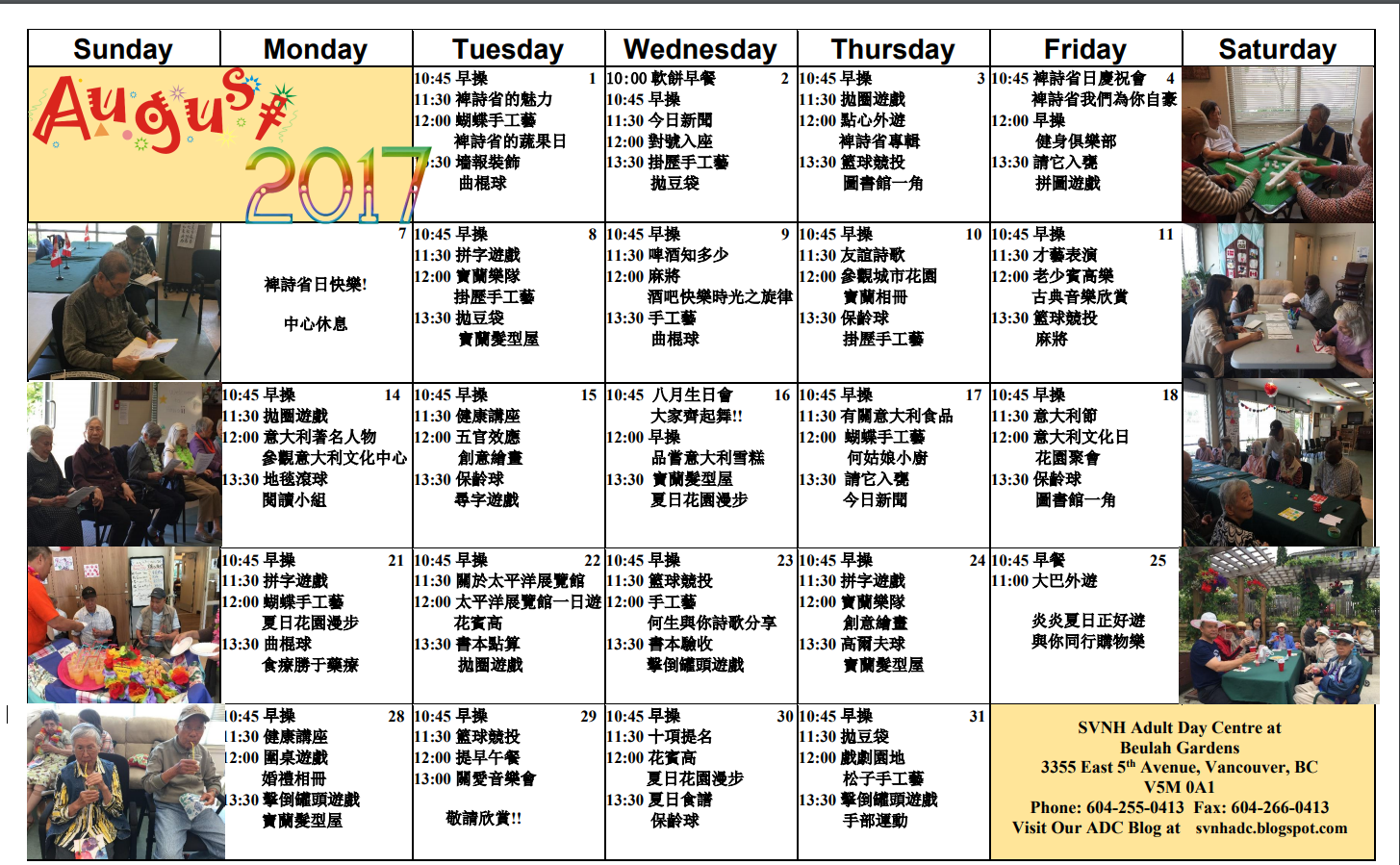
Beulah ADP August Calendar 2017

Please click on the images to see a larger picture.


Parkinson Society BC Study

Advanced Parkinsons Disease Study
Parkinson Society British Columbia (PSBC) advocates for improved awareness and treatment options for the Parkinson's community. One element of our advocacy plan is to seek an expansion of the Deep Brain Stimulation (DBS) program. DBS is a surgery that may be suitable for a small number of patients with advanced Parkinson's disease (PD). The surgery has enabled people to live independently in their own homes for many more years than they would otherwise be able to; however, patients experience long wait times for the procedure due to funding limitations.
Currently, the Health Technology Review (HTR), a joint Ministry of Health and Health Authority process, is seeking to explore which new non-drug health technologies should be publicly funded in the province of British Columbia.
A study will be conducted involving people with Parkinson's to gain an understanding of outcomes important to patients and their perceptions and experiences of the treatments available for advanced stage Parkinson's disease. The evidence and recommendations derived from this study will be used to evaluate clinical literature and health policy. 
If you have experience with advanced Parkinson's disease and would like to share your experiences, you are asked fill out this form and return it to the contact information provided.
Eligibility criteria:
  • Must be a resident of BC
  • Must be proficient in speaking English
  • Must be older than 19 years of age
  • Comfortable sharing their experiences with advanced stage Parkinson's disease
  • People with advanced Parkinson's, carepartners and those who have had DBS are invited to participate
  • Able to receive incoming calls within BC without any additional fees
For more information on the Health Technology Review process, please contact Selva Bayat at 604-875-4111, ext. 61732.R

Thursday, 20 July 2017

Jointly: the care coordination app

Developed by Carers UK, Jointly is a mobile and online app that can make life better for the millions of people looking after a loved one. Jointly helps make caring easier, less stressful and more organised.

  • One central place to store and share the important information about the person you are looking after.
  • Simple, intuitive group communication to keep everyone informed and better connected.
  • Shared calendar, task lists and medication manager to help co-ordinate responsibilities and organise what needs to be done.
  • Works across different devices: smartphone, tablet or home computer / laptop.

Tuesday, 4 July 2017

SOUTH VANCOUVER ADP JULY 2017 NEWSLETTER & CALENDAR 


Please click on the image to see a larger picture.